
GYXTZY type armored cable, indoor/outdoor, нг(А)-HF jacket
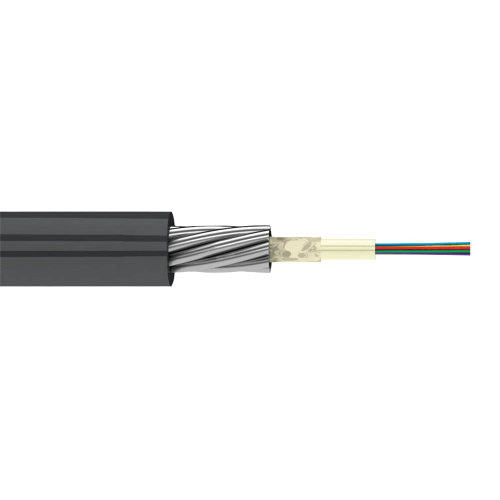
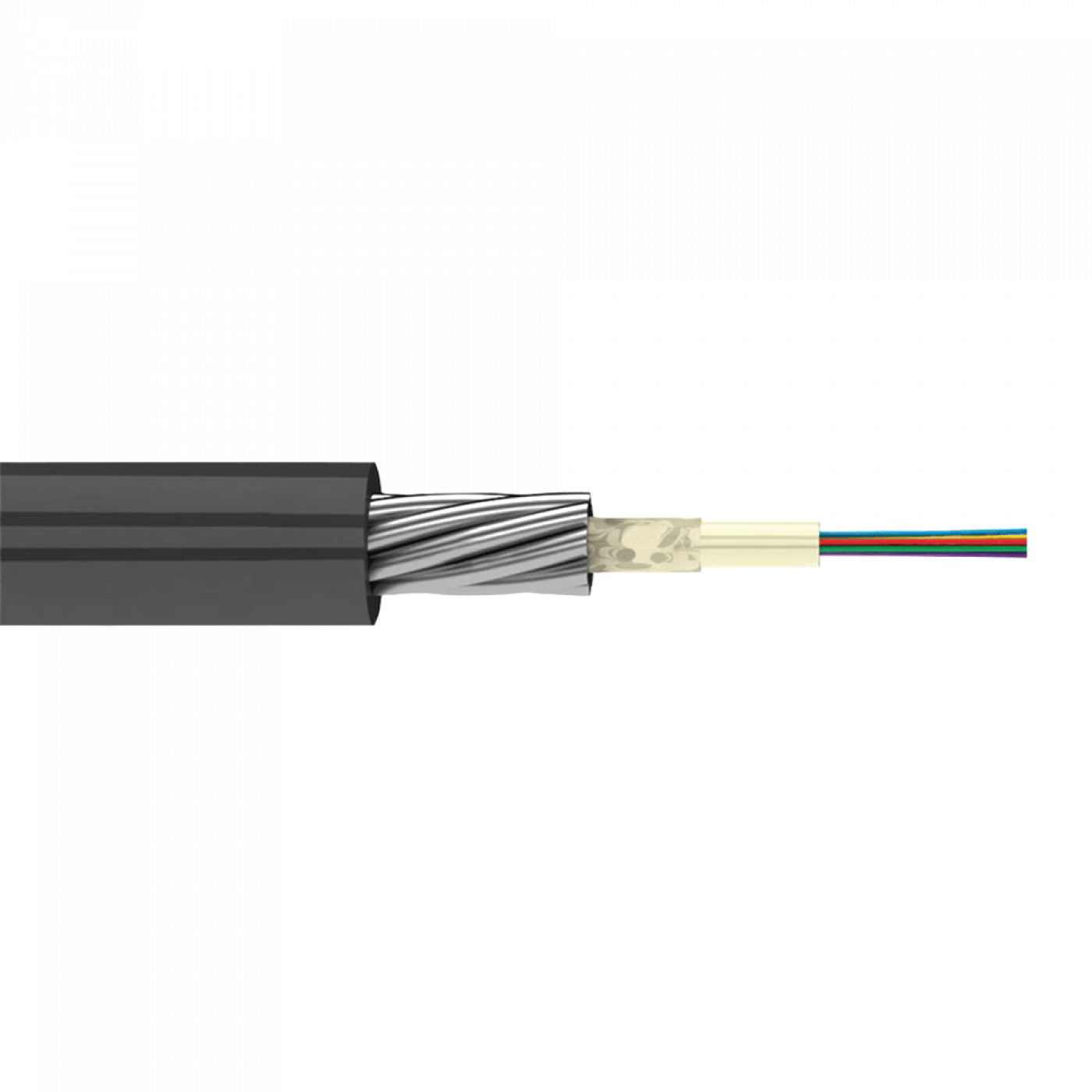
Used for laying in the ground, including swamps and shallow non-navigable rivers, cabling in cable ducts, pipes, trays, tunnels, collectors, over bridges and overpasses, between buildings, and inside buildings.
Design
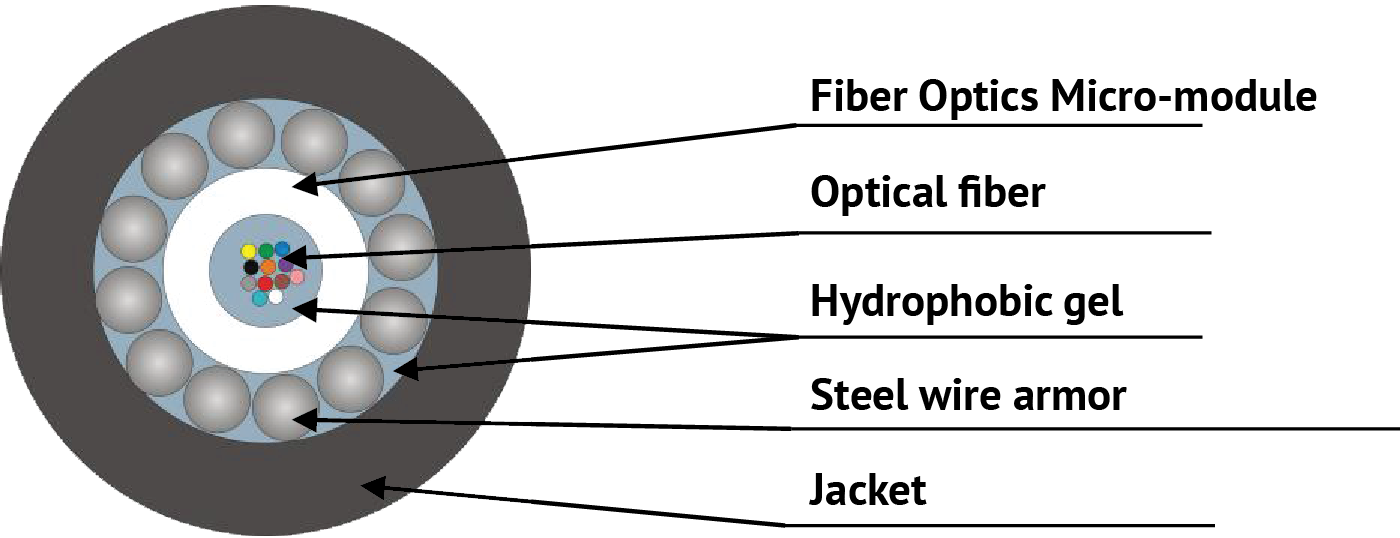
The cable contains a central optical module with loosely laid fibers. The free space in the optical module is filled with a hydrophobic gel. Steel wire armor is spirally covered over the central optical module. The free space between the wires is filled with a hydrophobic gel. The armor is covered with a jacket made a flame retardant, halogen free, low smoke emission, resistant to UV radiation polymer composition.
Color identification of buffered optical fibers
| № | Fibers 1-12 | № | Fibers 13-24 |
| 1 | Blue | 13 | Blue + 1 ring |
| 2 | Orange | 14 | Orange + 1 ring |
| 3 | Green | 15 | Green + 1 ring |
| 4 | Brown | 16 | Brown + 1 ring |
| 5 | Grey | 17 | Grey + 1 ring |
| 6 | White | 18 | White + 1 ring |
| 7 | Red | 19 | Red + 1 ring |
| 8 | Black | 20 | Black + 1 ring |
| 9 | Yellow | 21 | Yellow + 1 ring |
| 10 | Violet | 22 | Violet + 1 ring |
| 11 | Pink | 23 | Pink + 1 ring |
| 12 | Turquoise | 24 | Turquoise + 1 ring |
Cables are classified into 2 types according to maximum pulling tension (type 1 – 2.7 kN; type 2 - 7 kN)
Weight and Dimensions
Fiber count in the cable | Up to 16 | Up to 24 |
|---|---|---|
| Cable with maximum pulling tension - 7 kN | |
Cable diameter, mm | 9,5 | 9,7 |
Cable weight, kg/km | 180,9 | 183,8 |
| Cable with maximum pulling tension – 2.7 kN | |
Cable diameter, mm | 8,0 | 8,3 |
Cable weight, kg/km | 110,5 | 118,8 |
Operating conditions
Operating Temperature | -50°С…+70°С |
Installation Temperature | -10°С…+50°С |
Storage Temperature | -50°С…+50°С |
Minimum Bend Radius | At least 10 cable diameters |
Lifetime | 25 years |
Physical specifications
Optical cable is resistant to the following impacts
Impact type | Nominal value | Criteria for evaluation | |
|---|---|---|---|
| Type 1 | Type 2 | ||
Pulling tension | 2,7 kN | 7 kN | Δα* ≤ 0,05 dB |
Crush resistance | 0,5 kN/cm | 0,7 kN/cm | |
Dynamic bending stresses | 20 cycles at an angle ±90° | ||
Axial twisting stresses | 10 cycles at an angle of ± 360° | ||
Impact (IEC 794-1-93 Е4 test procedure) | Impact energy is 20 J | ||
| Water resistance (IEC 60794-1-2 para. 25, F5B test procedure) | Sample length: 3m | No water at the end | |
| Climatic impact low and high temperature resistance (IEC 794-1-93 F1 test procedure) | - temperature range from minus 50 to 70 °С | ||
| - 2 cycles | |||
| - cycle duration ≥ 16 hours | |||
| Climatic impact - precipitation (GOST 20.57.406, 218-1 test procedure) | - 2 hours | No cracks or other damage | |
| - salt fog (GOST 20.57.406, 215-1 test procedure) | - 2 days | ||
| - dew and frost (GOST 20.57.406, 206-1 test procedure) | - 2 hours | ||
| - solar radiation (GOST 20.57.406, 211-1 test procedure) | - 5 days | ||
| Dripping of hydrophobic compound (IEC 60794-1-2 E14 test procedure) | at 70 °С | No dripping | |
| Voltage test (GOST 2990-78) | AC Voltage 10 kV, 50 Hz | No breakdown | |
| Pulse spreading current (К.25 МСЭ-Т) | - duration 60 μs | Δα* ≤ 0,05 dB | |
* - increase in attenuation of an optical fiber in a cable at specific wavelengths.
Applicable optical fibers
SU | Single-mode fiber with extended operating wavelength and reduced attenuation and low bending loss (ITU G.652D+G.657.A1 recommendation) |
S2 | Single-mode fiber with an extended bandwidth of operating wavelengths (ITU-T G.652D recommendation) |
S5 | Single-mode positive non-zero dispersion shifted fiber (ITU-T G.655 recommendation) |
S7 | Single-mode with low bending loss (ITU-T G.657 recommendation) |
M1 | Multi-mode with core to cladding ratio 62,5/125 μm (IEC 60793-2-10 A1b type recommendation) |
M2 | Multi-mode with core to cladding ratio 50/125 μm (ITU-T G.651 recommendation and IEC 60793-2-10 type A1a.1 requirements) |
M3 | Multi-mode with low bending loss and core to cladding ratio 50/125 μm (ITU-T G.651 recommendation and IEC 60793-2-10 A1a.2 type requirements) |
M4 | Multi-mode with low bending loss and core to cladding ratio 50/125 μm (ITU-T G.651 recommendation and IEC 60793-2-10 A1a.3 type requirements) |